Muse or Grok Bot? A Practical Guide for Physicians Choosing an AI Assistant
Muse offers a free starting point for everyday tasks; Grok Bot is built for repeatable team workflows. Neither is described as covered for patient information.


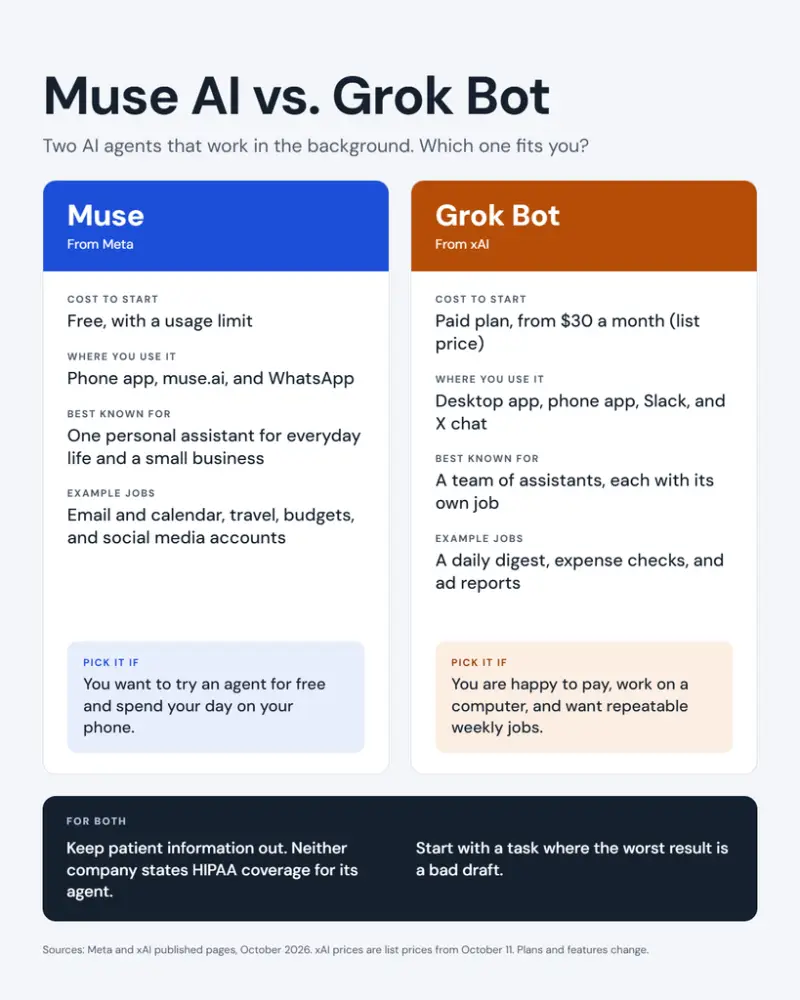
For physicians considering an AI agent, the first decision is less about which one is smarter and more about the work you want to hand off. Muse is designed as one assistant for personal errands and small business tasks. Grok Bot lets you set up several assistants for repeated jobs, with a stronger emphasis on computer based work and teams.
Both can work through connected apps and continue tasks in the cloud after you close the app. That reach can save time, but it also means you need to check what an agent is doing before it takes consequential actions. Neither company describes its agent as covered under HIPAA, so patient information should stay out of both.
At a glance
| Muse | Grok Bot | |
|---|---|---|
| Starting cost | Free, with a usage limit | Paid plan, listed from $30 a month |
| Where it works | iPhone and Android apps, muse.ai and WhatsApp | Desktop and phone apps, Slack and X chat |
| Best fit | One assistant for personal tasks and small business | Several assistants for assigned, repeatable jobs |
| Patient data coverage | No HIPAA coverage stated | No HIPAA coverage stated |
What changes when an assistant acts for you
A chatbot responds to a prompt and waits for the next one. An agent can take a task, use a computer in the cloud to work through steps, and keep going after you leave. Muse and Grok Bot can connect with tools such as email, calendars and accounting apps. Both are intended to ask before actions like sending, buying or deleting.
That design makes the review step part of the work. A draft email or a prepared expense list is easier to check than an action that has already gone out or changed a record. Meta recommends beginning with low risk tasks, and xAI suggests starting with work where the Bot prepares something for you to review. For a first trial, choose a task where an imperfect result is easy to correct.
Muse: one assistant across everyday tasks
Meta launched Muse on September 8, 2026, and says it is available in the US. You can message it through its app, muse.ai or WhatsApp. The company says it can help with email and calendar work, travel bookings, forms and budget tracking.
For small businesses, Muse adds connections to services including QuickBooks, Slack, Zoom, Canva and Shopify, along with Facebook and Instagram business accounts. That mix may suit a physician who wants to try an agent without paying first and already handles personal or side business tasks on a phone. Free access has a usage limit, so check whether the amount of use fits your routine.
Grok Bot: assistants with assigned jobs
xAI launched Grok Bot in beta on August 11. Instead of relying on one assistant for everything, you can create several named Bots and assign each a role. Examples from xAI include a chief of staff that prepares a daily digest, an expense manager that matches receipts and flags missing information, and assistants for sales outreach or ad reports.
Grok Bot is available through desktop apps for Mac, Windows and Linux, a phone app, X chat and Slack, according to xAI’s documentation. Bots can repeat work on a schedule. A feature called Teach a task can let a Bot learn a browser workflow by watching you perform it, though xAI says that feature is rolling out gradually.
This setup may work better for a practice or business with recurring administrative jobs and more than one person involved. The listed starting price is $30 a month. xAI also says the product may suit people who already pay for Cursor, SuperGrok or an X subscription at Premium level or above; check current plans and access details before deciding.
Account access and privacy details
Muse runs on a private computer, Meta says, with a separate gatekeeper program approving anything that leaves it. Meta says Muse cannot see passwords or payment details and provides an Activity log of its actions. Users can opt out of having chats used for training. Meta’s research post also says staff access is limited by policy, while allowing access when needed to run the service. A stricter version, Muse Confidential VM, was planned for later in 2026.
There was also a sharing issue to consider. In October, security researchers found that pages shared from Muse could be located through public web records. Meta paused sharing, addressed the issue and turned sharing back on October 22. Meta said shared documents and images were affected, rather than chats. If you plan to share files, review the available settings and keep sensitive material out.
xAI’s security documentation says all Grok Bots share one cloud computer, including its files and logins. Separate Bots therefore do not create separate security boundaries. Its FAQ says Grok Bot requires cloud storage, does not support Cursor’s Legacy Privacy Mode and follows the training settings on your Cursor account. xAI says the system selects an AI model for each task, which may include models from outside companies on a published list. A shared Bot link reveals its setup, so remove secrets before sharing one.
On patient information, neither company says its agent is covered under HIPAA. The reviewed Muse materials did not mention HIPAA or a Business Associate Agreement. xAI’s BAA request page concerns its APIs. These details don’t establish that either agent is suitable for patient records; check with your organization’s compliance team and keep patient information out unless the relevant coverage and terms have been confirmed.
Choosing a starting point
Muse looks like the simpler first trial if you want a free option, work mainly from your phone or WhatsApp, and need help with errands such as scheduling, travel, budgeting or small business accounts. Grok Bot may fit better if you prefer working on a computer, can justify the monthly cost and want distinct assistants to prepare recurring tasks for review.
A physician with a side business might test Muse on a low stakes calendar or email task. Someone managing a practice might assess Grok Bot with a recurring expense check or daily digest. In either case, review the output before anything is sent, purchased or changed, and recheck current pricing, features and privacy settings before connecting accounts. Both tools are new and can make mistakes; a useful first test is one with a clear result and little downside.